Tuesday, April 16, 2013

Figures... a practice of the human form and my process of achieving my latest sculpt


I've drawn and painted human bodies and faces from life countless times throughout my artistic background, but had never before done a sculpt of the human form.  So, when I lit upon the idea of sculpting a female figure as Mother Nature for the last PCAGOE monthly challenge, I knew it would certainly be a challenge. But, given my background of studying the human figure for drawing or painting, I was fairly confident that it was a challenge I could meet. The challenge theme for April was "the Seasons" (Spring, Summer, Autumn and Winter). My idea was to create Mother nature and decorate her form with the progression of the seasons; with the idea of a spring seed sprouting from her one hand, the vine continuing up her arm and onto her torso; leafing out in the full foliage of summer on her torso; eventually leading to vine down her other arm, turning to fall colors with two falling leaves which dangle from that hand. The thought to add winter to the bottom of her form, brought about the idea of a base where her torso blends into a tree trunk, with bare branches reaching outward.

This female figure concept initially began about a year ago, when I purchased a couple bottles of Vanilla Extract that happened to be hourglass shaped.  I instantly thought "female form" when looking at these bottles.  I thought perhaps I might do a miniature polymer dress form mannequin someday.  When I struck upon the idea of Mother nature for this challenge, I immediately thought of using one of those bottles.  So, this sculpture is a working bottle.  The next photo shows the sculpture with an example of what is at her core:

The following is a description of my working process to create the Mother Nature bottle sculpture:  The empty glass bottle was first fitted with 2 pieces of wire that were twisted together at both ends, leaving an opening in the center, through which the neck of the bottle was placed.  This created the armature for her arms.  The wire rests on the areas of the bottle which define the form's collar bones and scapula area on the back (next time I make one of these I will photograph this step), so it actually helped to define the collar bones of the form.  The wire was glued into place on to the bottle with super glue.  The tree trunk base has a core that is a cardboard spool which once held a skein of thread.  The head is supported with a screw that was driven through the metal cap of the bottle.  Her head fully unscrews from her body, as you can see in the first photo at the beginning of this post.

In the next handful of photos you can view a sampling of the progression of the sculpt.  In the first photo, you can see the rough sculpt of the body and arms, shown with one of the bottles, and my human anatomy for artist's book (which was my guide in getting the form right, since I didn't have access to a live model).  Take note too, of the screw protruding from the cap on the sculpted body, this is the armature for the head, ensuring that the bottle can be opened without having her head pop off the cap! 

The next photo is basically the next stage of the sculpt, adding more weight to her arms and the 1st sculpt of her head. 

At this next stage, a little more weight was added to her arms and her face is starting to take shape (more layers were eventually added to the face for better feature proportions).... you can see how rough her skin looks at this point (I don't have those nice silicone sculpting tools; I was working with my knife, my fingers, a pointed needle tool and a small round metal burnisher).  This was the stage when my husband saw her for the first time; his first comment was, "why did you make her so old and ugly?"... after he was banished from my studio ;)  I set out on the next step, baking her a second time.
 

After the second baking, she went through a sanding process to smooth out the bumps and ugliness so honestly pointed out my my dear hubby, and this was the result:


After this stage, she was coated with translucent liquid polymer and baked (two times) to give the skin a nice finish.  Finally, her torso was attached to the tree trunk base (which was sculpted with wire added to create the bare branches of the tree and baked separately).  Clay was sculpted over the join of the torso and tree trunk base to hide the seam and she was baked again.  The seed, vines and leaves were added, facial features were enhanced (eye lashes, eyebrows, color to her lips and highlights to the whites of her eyes) and she was baked to cure the final details.  I lost count, but I think she was baked a total of 8 or 9 times from beginning to end.  Her hair is made from angora fleece and was attached section by section to her head with super glue, which was a messy job; there has to be a better way to do this part, which I will be researching before my next human form. (Yes, a "next one" is already in planning stages and will be a "sister" to Mother Nature).  As a final touch some translucent gloss acrylic was added to her eyes and lips for shine. By this time, it was 11PM on the night of the midnight deadline for my guild's challenge, so I took a photo of her at night, at a bad angle and without adequate lighting... which resulted in a sinister look on her face (that photo is in my flickr if anyone didn't see it in the challenge entries).  Before I took daylight photos, I noticed that the vines on the front of her torso were off balance and threw the entire design off... so the next morning I set to work to fix that imbalance, happily forgetting to get daylight photos to include in my flickr and to add links to my challenge description.  That is why I held off in posting the daylight photos of her here and on my flickr until after the challenge voting ended. 
While I am fairly happy with how she turned out, her torso sculpt is the area with which I was most pleased, especially her back.. I was also especially pleased with the vine design on her back.  The front of the torso could use improvements, the same is true of her hands.  The area which I think begs for the most improvement is the face sculpt, it just did not turn out as well as I had hoped.. more study to do in that area for female body #2 which is coming soon...  Mother Nature is available in my etsy shop.

Friday, April 5, 2013

Two more days!

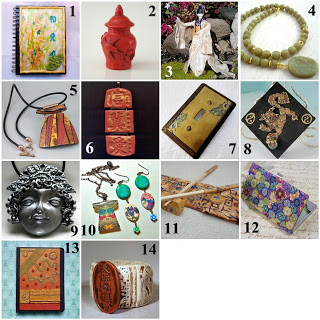
Time keeps slipping by too fast for me to get a grasp on everything!  There are only 2 more days left to vote for this month's guild challenge (as of this posting on 4/5/13).  So please head on over to the PCAGOE blog to vote!  Here are the awesome entries for this month:


I did enter a piece this month: the mother nature art doll bottle.  I will post more about her after the challenge, because.....

After she was finished (so I thought) I spent the last hour before the midnight deadline trying to get a photo of her posted to the flickr pool (a last minute entry, even though I began her at the end of February/beginning of March).  Once I finally got the photo posted; I was scrutinizing the photo, fretting over how bad it turned out, because of my inadequate lighting. I pretty much just turned on all the lights on the first floor of my house to photograph her, because I don't have a lighting set-up for indoor photographing.  The wrong lighting is just as bad on a sculpted figurine as it can be on us humans.  When will I learn to give myself enough time to finish a challenge at least the day before the deadline, so I can get daylight photos?!?  I've made this error too many times to count.  (mental note: since I can't seem to get most of my pieces finished before the night of the entry deadline I need to work on a better lighting set-up)  While scrutinizing this horrible photo, I realized that the balance of the design was completely off. (mental note 2: remember old school trick of holding item in mirror to get different perspective to notice flaws in design easier)  The next day my fingers were itching to fix the problems.  I forgot about getting a better daylight photo to post for linking to my challenge photo (as I've done in the past).  After I had fixed the design issues, I happily took my daylight photos and realized that I didn't have "before" daylight photos.  So, I didn't feel right about posting the new photos on my flickr because my fellow guild-mates did not get that extra time to work on their pieces.  I did post a photo of her back side to flickr because I didn't do any re-touching to that side; that photo can be seen in my flickr photostream under better (daylight) lighting conditions.  I will post more about her and my creative process with better photos after voting has closed on April 7th (midnight EST).  So please, do head over to the PCAGOE blog and vote for your 3 favorite entries, you might win a prize! (3 lucky voters are chosen for a prize every month)  And please check back next week for the new photos and the story of how my mother nature art doll bottle was created!

Monday, March 4, 2013

Star Light Star Bright

It's time again for voting.  The March PCAGOE challenge theme was Celestial (Sun, Moon, Stars, etc.).  My idea was a multi-layered, dimensional, star shaped night light. Constructed of 3 layers and various cuts to reveal the different layers and allow the light to shine through.  The base layer is made of translucent clay with gold mica. The second layer is a mixture of red and translucent with the star arms of this layer cut into shapes that would leave an open star shape in the center, revealing first layer. The third layer is a mix of purple and translucent, the star arms again were cut into shapes that would leave another center open star shape, revealing the red layer outlining the original center cut out star. Some circle cut-out shapes were included in the layers on each of the star arms; one to reveal the red layer, one to reveal the first translucent gold layer and 2 smaller holes that were cut through all 3 layers to reveal complete negative space. After curing, sanding and buffing, as a final element, spirals were drawn onto the purple layer using an embossing pen and gold embossing powder which was heat set. I fabricated a clay piece for the light fixture attachment and the final step was to glue that in place. Below are 2 photos of the piece, unlit and lit...  For more views of this piece please visit my flickr photo stream.


 And here are the other entries, all stellar examples of how versatile the polymer medium truly is!

Please remember to go vote at the PCAGOE blog before midnight 3/7/13 EST!

Wednesday, February 6, 2013

A little bit rusty, a little bit busy

 I've been tied up with a custom order lately, so I haven't had the chance to post any new items to any of my shops; I haven't had time to play with my new purple kiln (more about that soon!); and I didn't have time to make a new piece for the challenge this month.  Fortunately, I had a recently made piece that I could submit for this month's Faux themed PCAGOE challenge.  If you have read my blog before, you will recognize it as the piece I made in the faux rusted metal tutorial which you can find here.  Here is a photo of that rusted metal pendant necklace:


You can view more photos of this necklace in my etsy store and my flickr photostream.  And here are the other artist offerings for this month's Faux challenge:


Ah, the possibilities with polymer seem endless!  And these pieces are so well done that the voting this month is another tough choice.  Speaking of voting, please do head over to the PCAGOE blog and vote for your 3 favorite entries!!  You could win a prize (3 lucky voters will be randomly chosen for a prize!).  You have until midnight on 2/7/13 to cast a vote, so if you're catching this post on the day I'm writing it, you only have a day and a half!


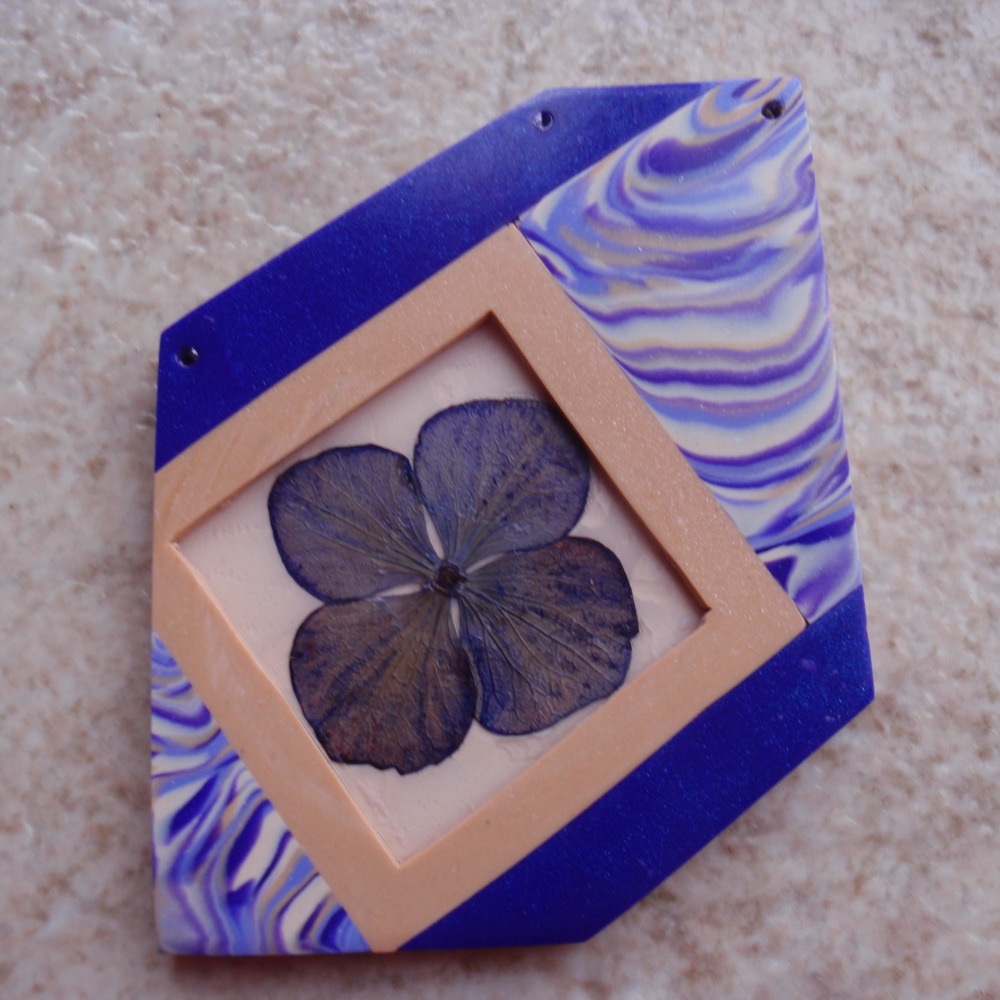
So, back to the custom order.  In total, I've made something like 22 pendants for this order.  No, the customer isn't going to buy all of them, I just like to give a customer lots of options when I'm given a somewhat open ended design request.  The good news is that the customer has decided to take 5 of the necklaces; 4 of which are completed.  The 5th is still in progress.  So I decided I'd share here what has been consuming my energies and free time this past month.  This particular customer had seen one of my necklaces with a real flower incorporated in the design in my artfire shop.  That necklace also had an unusual asymmetrical hanging design.  The only parameters were to create a piece with the asymmetrical necklace hanging design, a hydrangea flower, and colors in the purple family.  Here are a few of the pendant options that I created (some of which only use a hydrangea petal, some have a skeleton hydrangea petal, and still others have a full hydrangea flower):


There are many more that I created, all of the extras will be popping up in my etsy or artfire shops.  And here are the 4 that were chosen by the customer and have been turned into finished necklaces (the 5th one is being cured today and will hopefully be finished and hung tomorrow):


Saturday, January 5, 2013

Can you feel it?

Texture... tactile art in polymer is always such a fun area to explore.  This is what my guild's challenge was for January 2013.  The artists were asked to come up with a piece using textural elements, made of at least 50% polymer clay; and we had a great amount of entries this month.  I had fun using a technique I've been playing with for a few months.  I'm calling the technique impasto polymer, though someone else out in the polymer world may have explored this idea also and may have called it something else; I'm not certain if this is something that has been done before, it seems so simple that I think it likely to have been done already...  Here's a photo mosaic of my entry and below that are the details on how I created the texture:


This pendant was created by taking a cut shaped slab of solid mint green polymer and dying it with silk fabric.  After the dying process, I then covered the one side entirely with navy colored polymer and scratched into the surface to reveal the mint green polymer below and creating the sunburst texture which you see in the largest of the photos.  On the reverse side, the silk dyed pattern was much more interesting so I simply accented that with some appliqued navy circle patterning (seen in the smaller middle photo).  After curing again, the textural elements were highlighted with some gold acrylic. I love unusual jewelry design with simplistic elements to keep the piece interesting yet not overwhelming; and it was with that view that I created the asymmetrical wandering seed bead hanging design, as seen in the top and bottom smaller photos.  More views can be found in my flickr photostream.  The piece is also available for sale in my etsy shop.

As I said, there were a lot of entries this month, all of them wonderfully crafted.  Here's a little look at them:

I'd say they're all winners!  Speaking of winners, you still have 2 more days to vote; so don't delay, go to the pcagoe blog and vote for your 3 favorite entries before midnight on January 7th 2013!  You could be one of the 3 lucky voters chosen to win a prize!


Thursday, December 6, 2012

Monochromatic Ornaments

Busy month, so not much time to post... but I wanted to share my entry for the December 2012 Polymer Clay Artists Guild of Etsy challenge.  This month's theme was monochromatic, or one hue and it's tints and shades.  My entry is a set of 3 dimensionally designed ornaments that were indeed a challenge for me to create.  I had seen the interlocking shapes idea from a wooden snowflake ornament and decided that I would try it out in polymer.  It took a while to get the proper gauge of the polymer and proper cutting, and a few days simply designing various shapes.  I think I designed about 20 different shapes which I hope to some day make, but if you know me, that may take a few years as I'm so scattered that I move right on to the next idea!  Still promising that Tiffany tutorial, just haven't had the time to get to it yet!  Any way, here are my ornaments for the challenge (this set is available in my etsy shop and more photos are on my flickr photostream:


Voting is still open, but you only have one more day!  Voting closes on Dec. 7th at midnight EST.  If you'd like to vote, please go to: http://www.polymerclayartists.blogspot.com/
If you do vote, you could be one of 3 lucky voters to win a prize!

Here are the other lovely entries, tough pick this month as they're all winners!


Saturday, November 3, 2012

Take-out Anyone?

So this month my guild's challenge theme was Asian.  My first thought on this challenge was to make a Chinese take-out box out of clay... but the logistics of working out how to hinge the sides in order for the box to be fully functional were a bit daunting... keeping with the genre of items I associate with Take-out, I struck upon the idea of covering the handles of a pair of standard bamboo chopsticks.  Wanting to do something more, I decided to also make a matching chopstick rest.  Initial idea settled, my next move was to consider the surface design of the polymer parts.  I have quite a few Asian inspired fabrics waiting to be incorporated into the perfect quilt or sewing project, so looking to my fabric collection for design inspiration was a given.  I chose a batiked fabric with Asian characters as my surface design inspiration… but I wanted to say something more than characters that mimic the fabric pattern, with meanings I could not decipher.  So, I decided to Google references and make canes of the Chinese character 吃 and the Japanese Kanji 食 for the word "Eat".  I also tried to emulate the background and colors of the fabric in the polymer surface design… and I turned a piece of the fabric into a little pouch with a matching polymer button, to complete the set for carrying the chopsticks and rest.
I'm not too experienced with making canes, this is something like my 3rd or 4th cane project ever, so this truly was a challenge for me to assemble and reduce these canes.  I was pleased with my results... what do you think??


More (larger) photos of this set can be found on my flickr and in my etsy shop.  Voting is already open for this challenge and will run through November 7th 2012 Midnight EST, so be sure to head over to the PCAGOE blog and cast your vote for your favorite 3 entries.  Three lucky voters will win their choice of prize... you could be one of them, but you have to vote to be entered!  Here's a peek at all of the fabulous entries that were created this month:


Aren't they all GREAT?!?  Please take a minute to go vote at the link listed above!

Thursday, September 6, 2012

Another Challenge and a Free "Rusted Metal" Polymer Clay Tutorial

I've been asked about the "how to" on my RUSTic Knot pendant which I created for the September PCAGOE Metallic themed challenge.  When pondering the challenge theme, I wanted to create a "rusty aged metal" look with polymer (and some other additives). … I was pretty happy with my result:


More photos of this piece can be found here.  Here are the other wonderful entries for this month's PCAGOE challenge.  Please go to the PCAGOE blog and vote for your 3 favorite entries before September 7th midnight EST.


Free Tutorial:
So, here's the scoop on how I created the rusty metal look(measurements are approximations)

Ingredients:
¼ bar of well conditioned transparent polymer clay
1 t. to 1 T each of paprika and chili powder
pledge Future floor finish
silver alcohol ink

Method:
Roll out the pre-conditioned clay.


Sprinkle with about ½ t. each paprika and chili powder and incorporate into the clay, keep conditioning the clay with the spice inclusions to incorporate.


Form your desired shape (adding any holes you may desire for hanging pendants, earrings, etc.) and coat the outer sides with more of the chili powder and paprika.


 Bake the clay according to the manufacturer's instructions.  Once the piece has cured and is cooled, take a razor blade or tissue blade dedicated to cutting cured clay and slice off some areas of the piece in thin layers, taking off some of the outer layer of spices.  When you do this, you are creating some smooth shiny areas and because of the spice inclusions, you will also find that small pits will form as you slice off areas, these pits will lend more to the aged look.


Then cover those areas (where you just removed some of the outer layer) with silver alcohol ink, plus cover a few of the areas where you didn't remove any outer layer, making sure that you leave plenty of "rusty" spots to achieve the look of real rusted metal…I use my fingers to smudge the ink in some areas to blend it into some of the "rusted" spots.


At this point you can even take a little water or alcohol and wipe off some areas of the silver to reveal some of the "rust" under a faint coloring of silver.  (as seen in the left hand side of the pendant in the first photo at the top of this post)  When you are happy with the look of your piece, take the whole piece and dip into a cup filled with Future floor finish to seal everything (or use a paint brush to coat with finish).


At this point I didn't want the "rusty" areas to be shiny from the sealer, so I then added more paprika to the areas I wanted to look like rust while the Future floor finish was still wet, using my fingers to bind it into place.  Adding only paprika to this stage also gives more of the rust look, as with rust, the under layers will be darker brownish color and the outer layers will have a more orange color.


Let the piece dry.  You can then add more silver alcohol ink to areas where you want the silver metal look to be stronger and more enhanced, but be sure to take a paintbrush with Future floor finish over any newly added silver ink to seal it onto the piece. Let dry thoroughly and then finish as desired.


*Note: if you dip your piece into the Future finish, you will find that flakes of the spices will fall off into the cup.  To keep these flakes from contaminating the rest of your floor finish (and not waste the whole cup), simply place a small piece of used dryer sheet over the mouth of your bottle to strain out the spice pieces as you pour the Future back into the bottle.*


Enjoy!  Any questions or comments, please don't hesitate to contact me directly or leave a comment here.  Feel free to share the link to this post with your friends, but please give credit and reference back to Create My World Designs.  And… if you use this tutorial to create something, please leave me a comment and a link to your flickr or blog with a photo of your creation so I can see your work!

Create My World Designs
©2012 text and photos

***I also want to mention; a few months ago I promised a free tutorial on how I made my Tiffany inspired faux stained glass lampshade.  I have not forgotten... I've just had an extremely busy summer in the garden in addition to a broken extruder (a tool that is essential with this project)!  I just got my new extruder and have the shade base all ready to go.  As soon as I get a bit more free time (hopefully within this month)  I will create and post that tutorial here too... thanks for your patience to anyone who has been waiting for it!